Search for the best blue light glasses and you'll find the same thing everywhere: lists of brands, ranked by nobody knows what. This guide takes a different approach. Instead of telling you which logo to buy, it explains how blue light glasses actually differ — and gives you four checks that separate a pair made for your kind of work from one that isn't.
We make blue light glasses ourselves, so read this knowing where we stand. But the framework below is the one we used to design our own frames, and it holds whether you buy from us or not.
Not all blue light glasses work the same way
Blue light glasses sit on a spectrum, and it's worth understanding before you buy.
At one end are amber and yellow-tinted lenses. The visible tint is doing real work — these lenses filter a larger share of blue light, and the deeper the tint, the heavier the filtering. They're a legitimate, well-established choice, and for some people exactly the right one. The trade-off is colour accuracy: everything you see through them, including your screen, shifts warm. Whites turn cream, blues mute, and the colours in your work no longer look the way they're actually displayed.
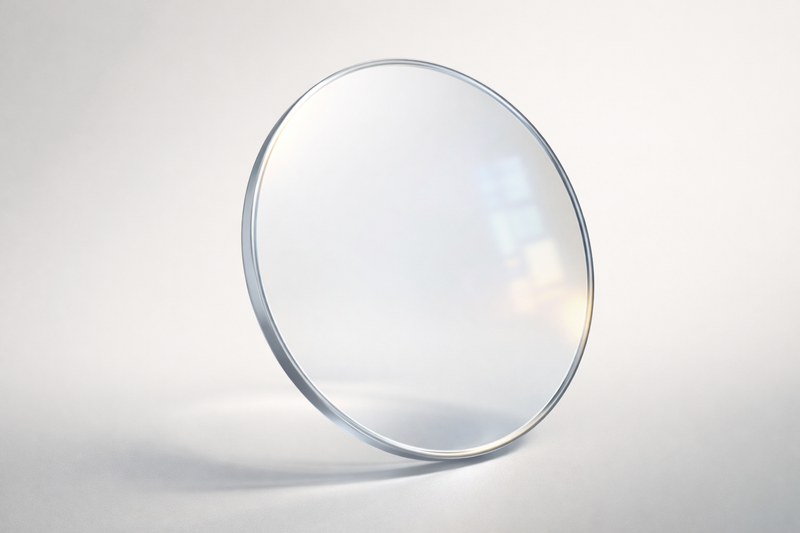
At the other end are clear-lens blue light glasses, which filter more selectively — targeting the blue-violet range while leaving the rest of the spectrum, and your screen's colours, essentially untouched.
Neither type is "better." They're built for different people. The question is what you need: if colour accuracy doesn't matter for your day, a tinted lens is a perfectly good tool. If you design, edit, photograph, build interfaces, or otherwise need your screen to tell you the truth, the tint becomes the problem — and a clear, selective lens is the right instrument.
How to choose blue light glasses: the 4 checks
1. Decide where you stand on tint
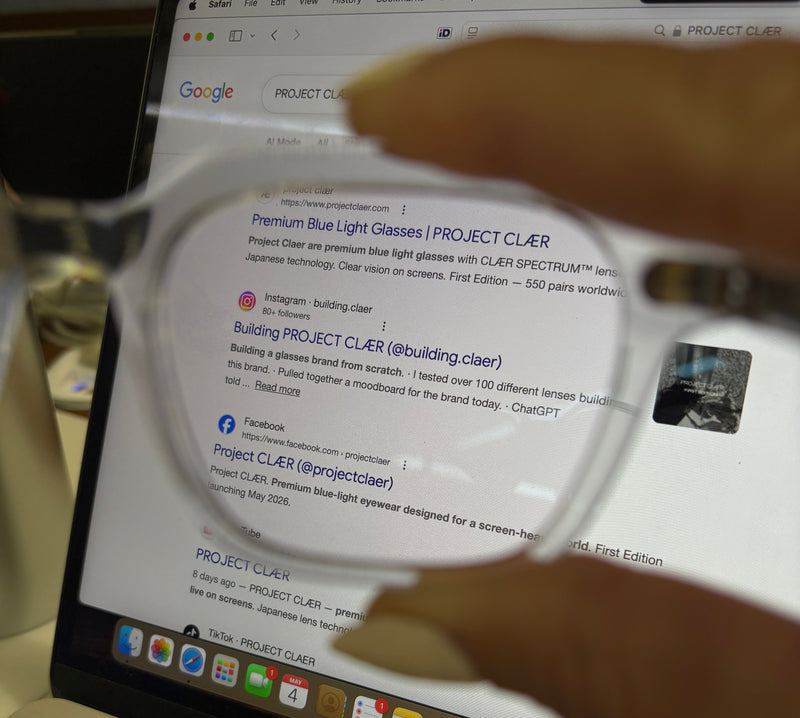
Hold the glasses in front of your screen with something colourful open, and look at what happens. A visible warm shift means heavier filtering — fine if that's what you want, a dealbreaker if your work depends on colour. A lens that reads clear against the screen keeps your colours accurate while still filtering the blue-violet range. There's no wrong answer here, only a wrong match: the mistake is buying a tinted lens for colour-critical work, or judging a lens without ever holding it up to a screen.
2. Ask how the filter is made — and ask for the test report
This is the check almost nobody runs, and it's the one that matters most.
There are two ways to put a blue light filter in a lens: a coating applied to the surface, or filtering infused into the lens material itself. A coating sits on top of the lens — it can scratch, wear at the edges, and degrade with every cleaning. An infused filter is part of the lens: it performs the same in year three as on day one, because there's nothing on the surface to wear away. Ask which one you're buying. If the brand can't answer, that's your answer.
Then ask for the numbers. A lens's filtering is invisible to the eye — especially on a clear lens — so the only way to know what a pair actually does is a spectral transmittance report from lens testing: a curve showing exactly which wavelengths the lens filters, and by how much. Very few brands publish this data. If a brand won't show you the curve, you're buying a claim, not a measurement. (We publish ours — the CLÆR SPECTRUM™ transmittance curve is on our Technology page.)
Whatever the filter, the lens should also hold up as an optical instrument: consistent clarity across the whole lens, a clean anti-reflective coating, no distortion at the edges. Look through the edge of the lens at a door frame; if straight lines bend, keep looking.
3. Real acetate, not painted plastic
Most frames under a certain quality bar are injection-moulded plastic dressed up to look like acetate. Real acetate is a cotton-based material that's cut, shaped and polished rather than moulded — it has visible depth in its colour rather than a painted-on surface, it can be adjusted by an optician for fit, and it ages well instead of going brittle. It also feels dense rather than hollow. Frames are where most of a pair's price usually goes; make sure the material is actually what it claims to be.
4. Fit for your face
The best pair is the one you'll actually wear for a full working day. That comes down to shape and proportion: round frames soften angular features, rectangles suit rounder faces, squares add structure. Check the measurements — lens width, bridge, temple length — against a pair you already know fits you. A beautiful frame that pinches by lunchtime is a drawer ornament.
An honest note about tint
Full transparency: any lens that genuinely filters blue-violet light has some tint — that's physics, not a flaw. Even on a clear-lens pair like ours, you may notice a very slight warmth if you hold the lens against a white wall. The difference is in degree and in design: a selective lens is engineered so that on screen — where you actually use it — it reads completely clear and leaves your colours alone. Judge any lens in the place you'll wear it.
The best blue light glasses for designers and screen workers
PROJECT CLÆR exists for one side of that spectrum: people who spend eight-plus hours a day on screens and need their colours to stay true. CLÆR SPECTRUM™ Japanese optical lenses filter selectively in the blue-violet range with the filter infused in the lens material — not a surface coating — and read clear against a display, with no warm shift over your work. We publish the spectral transmittance curve on our Technology page, so you can see exactly what the lens does. The frames are hand-finished acetate in three shapes — SOL (round, soft, classic), VERA (rectangle, editorial) and NORD (square, architectural) — each in two colourways at $129. The First Edition is limited to 550 pairs, packaged in a machined aluminium tube with a suede pouch.
If heavier filtering is what you're after, a quality amber pair will serve you well. If colour accuracy is non-negotiable, that's the gap we built for.

Blue light glasses: quick answers
How do I know if blue light glasses actually filter anything?
You can't tell by looking — especially with clear lenses. Ask the brand for a spectral transmittance report from lens testing, which shows exactly which wavelengths are filtered and by how much. Brands that have the data tend to show it.
What's the difference between a coated and an infused blue light filter?
A coating is applied to the lens surface and can scratch or wear over time. An infused filter is built into the lens material itself, so the filtering doesn't degrade with use or cleaning.
Do blue light glasses tint your screen?
Some do, by design — amber and yellow lenses filter more heavily and shift everything warm. Clear-lens blue light glasses filter selectively and leave your screen's colours essentially unchanged. Hold any pair up to a screen before you buy.
Are yellow blue light glasses better than clear ones?
Neither is better — they're different tools. Yellow lenses filter a larger share of blue light; clear lenses trade some of that intensity for colour accuracy. Choose based on whether your work depends on seeing colour correctly.
What is acetate, and why does it matter?
Acetate is a cotton-based material that's cut and polished rather than injection-moulded. It's more durable, adjustable for fit, and has a depth of colour that painted plastic can't imitate.
Which frame shape should I choose?
As a starting point: round softens angular features, rectangles balance rounder faces, and square frames add structure. Comfort over a full working day matters more than any rule.
— PROJECT CLÆR